
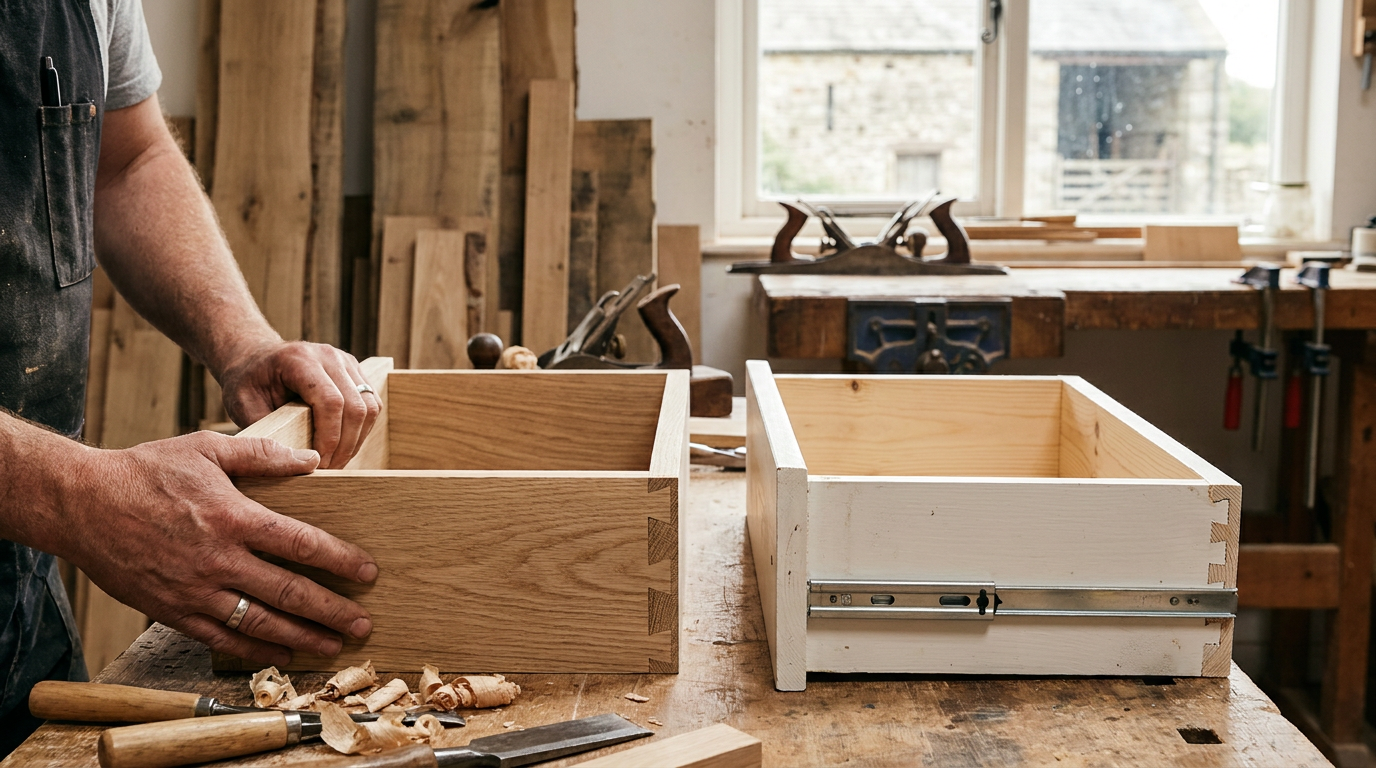
Dovetail Drawers vs Standard: Which Should You Choose?
Dovetail drawers vs standard boxes comes down to how the corners are joined: dovetails interlock mechanically with wedge-shaped tails and pins, while standard drawers rely on staples, nails, screws, dowels, or glue alone.
Quick answer: dovetail drawers vs standard
Dovetail drawers join boards with interlocking wedge-shaped tails and pins that lock together mechanically, while standard drawers rely on staples, nails, screws, or glue alone.
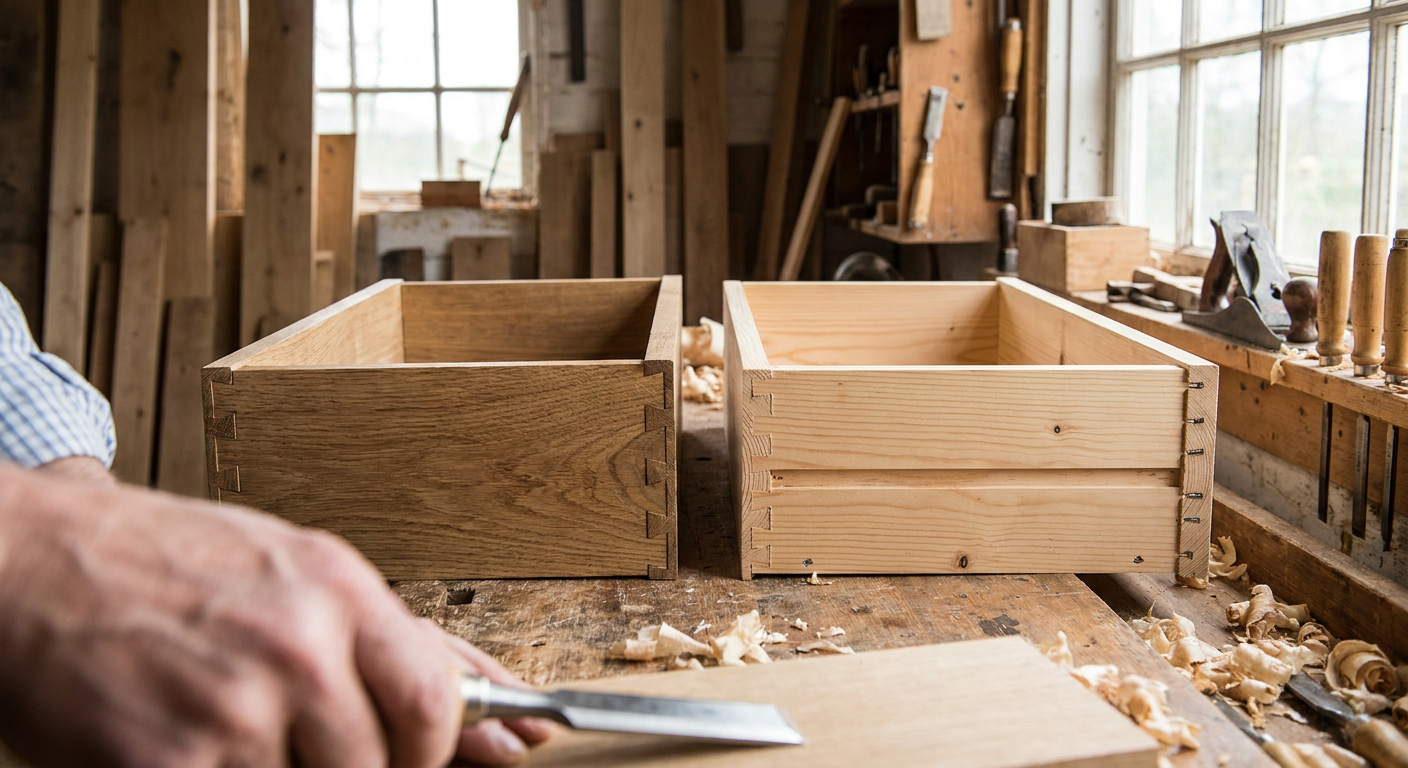
In the kitchens and furniture we hand-build at Oak & Pine by Design, the difference shows up in how a drawer feels after twenty years of daily use, which is why our dovetail drawers vs standard guide starts there.
What are the disadvantages of dovetail drawers?
The honest drawbacks are cost, build time, and repair difficulty, because a hand-cut dovetail drawer takes two to four times longer to produce than a stapled one. That extra labour pushes price up, and if a single tail is knocked out the joint is harder to rework than a loose staple. For shallow, light-duty pieces such as a bedside cabinet holding a few paperback novels, the investment rarely pays back. The joint also rewards accuracy: a poorly cut dovetail is weaker than a clean butt joint, so a careless machinist can ruin what hand tools would have produced. Reclaimed pine boxes built with standard joints often suit those quieter roles just as well, which is part of the dovetail drawers vs standard trade-off.
Why are dovetail drawers better?
A dovetail joint resists pulling in two directions at once, so the drawer box stays square and tight even as the timber moves with seasonal humidity. In our Yorkshire workshop we have refurbished ten-year-old kitchen drawers where the boxes were still rigid while the soft-close runners had simply worn out. That mechanical lock is why a dovetail drawer can carry a heavy cast-iron set or stacks of lever-arch files without the corners racking open, and it is the core argument in the dovetail drawers vs standard debate.
Is dovetail the highest quality?
For drawer construction, dovetail is widely regarded as the strongest and longest-lasting joint a cabinetmaker can cut, which is why it appears on the inside of the finest heirloom furniture. It is not the only measure of quality; a well-fitted box with premium runners and properly seasoned hardwoods matters as much, but the dovetail is the joint most often left visible as a quiet badge of craftsmanship, and Guild of Master Craftsmen-accredited workshops use it as a benchmark for bespoke handmade kitchens in oak and bespoke kitchens and furniture work.
What is a dovetail drawer?
A dovetail drawer is a box assembled from solid timber boards whose corners carry interlocking wedge-shaped cuts. The tails on one board lock into matching pins on the adjoining board, creating a mechanical joint that grows stronger under load rather than weaker.
What is a standard drawer?
A standard drawer is typically a box made from plywood, MDF, or solid timber panels fastened with staples, nails, screws, or glue at the corners. It is quicker to produce and cheaper to buy, but depends on the fasteners and adhesive alone to hold it together.
Dovetail joint construction and design
The joint is cut so the tail flares outwards like a swallow's tail, trapping the pin board behind a wider shoulder. Through dovetails show on both faces for a traditional look, half-blind dovetails hide the joint from the drawer front for a cleaner line, and English and French variants trade interior space for specific applications. We keep a sample dovetailed drawer box on the bench for clients to handle; the wobble-free feel of a true dovetail corner needs no explanation once you lift it, and it is the clearest answer in the dovetail drawers vs standard question.
Next step: bring a tape measure and a rough sketch of what you want made to your free design consultation, and we will talk you through whether dovetail construction fits your budget, your room, and how you actually use your drawers.
What a Dovetail Drawer Is and How the Joint Works
Through, half-blind, and English dovetail explained
A dovetail drawer is a box joined by interlocking wedge-shaped pins and tails that lock together mechanically, without relying on nails, screws, or staples. Each tail flares outward, matching a precisely cut socket in the adjoining board, so the two pieces resist being pulled apart in any direction. The joint's strength comes from geometry rather than fasteners, which is why fine drawer boxes survive decades of daily use.
Three variants appear most often in handmade British cabinetry, including shaker styles where a clean drawer front is part of the design language. A through dovetail shows the joint on both faces of the drawer; it is the classic look you see on heirloom furniture and the strongest of the three because every tail is fully exposed and locked. A half-blind dovetail hides the joint from the front so the drawer face stays clean, sacrificing a small amount of glue surface for a tidier appearance. An English dovetail adds a row of small pins along the top edge of the joint, increasing the gluing area and pulling capacity while still concealing the tails from the front.
Dovetail joint construction and the materials that suit it
Cutting dovetails by hand requires marking out each tail and pin with a cutting gauge, sawing to the shoulder line, and paring the waste with a chisel until the joints slide together without forcing. In our Yorkshire workshop, founder Daniel Fitzpatrick cuts most drawer joints by hand for premium commissions and uses a Leigh jig for production runs where consistency matters more than visible hand-cut variation. As a member of the Guild of Master Craftsmen, Daniel holds our bespoke handmade kitchens in oak and bespoke kitchens and furniture work to a single workshop standard, with one workshop handling all ranges from painted shaker to traditional in-frame, including reclaimed pine carcasses where the timber's history suits the brief. The process is slower than a stapled or dowelled box, often adding several hours per drawer.
Material choice affects how the joint behaves. Tight-grained hardwoods such as oak, beech, maple, and mahogany hold crisp tails and resist splitting, making them the standard pairing for hand-cut drawers. Maple dovetail drawers in particular cut cleanly and take a fine finish. Softer pine, including reclaimed pine boards we salvage for character pieces, works for painted drawers where the joint is hidden. Plywood and MDF can be dovetailed, but their layered edges chip more easily, so we specify solid timber for drawer sides and thinner plywood only for drawer bottoms where strength demands are lower.
Choosing between dovetail drawers vs standard construction often comes down to how long you want the drawer to last and how much weight it must carry day after day.
What a Standard Drawer Is and Where It Falls Short
A standard drawer uses a simple construction method, where the front, back, and sides meet at right angles and are held together with nails, staples, screws, or glue. There is no interlocking joinery. Mass-produced kitchen and bedroom furniture rely on this method because it is fast, repeatable, and cost-effective, which is why the dovetail drawers vs standard comparison is really a choice between speed and longevity.
Common joint types used in standard drawer boxes
- Butt joint: two flat boards meet end-to-grain. The weakest option, dependent entirely on adhesive and fasteners.
- Rabbet joint: a small recess cut into one board receives the edge of another. Slightly more gluing surface than a butt joint, still reliant on fixings.
- Dowel joint: wooden pegs align and reinforce the corner. Common in flat-pack ranges where consistency matters more than longevity.
- Biscuit joint: compressed beech wafers slot into matching cuts. Quick to assemble, but the bond weakens if the drawer is ever flooded or stored in damp conditions.
Each of these joints serves a purpose on a production line. They keep unit costs down and lead times short. None of them, however, do anything to resist the lateral pulling force a drawer experiences every time it is opened while full, which is the central weakness in the dovetail drawers vs standard match-up.
Why standard drawers fail sooner under heavy use
The weakness sits at the corner, where the side panel meets the front. Repeated loading and sliding creates shear stress on the fasteners. Nails back out. Glue lines creep, especially in kitchens where humidity changes through the year. A drawer that once slid smoothly begins to rack. The bottom panel often drops first because it is usually a thin hardboard or MDF sheet simply pressed into a groove and stapled.
In our Yorkshire workshop we have rebuilt kitchen drawers for clients whose original units were only six or seven years old. The carcasses were fine; the drawer boxes had split at the corners or shed their bottoms entirely. Compare that to the oak and maple dovetail drawers we made for the same households as replacements, which are now twenty years in service and counting. The pattern holds across jobs: standard drawer boxes have a working life of roughly one cycle of decorating before they need attention, whereas a properly jointed dovetail drawer outlasts the cabinet it sits inside.
Are Dovetail Drawers Better, and Are They Worth the Cost?
Why are dovetail drawers better than alternatives?
Dovetail drawers outperform standard construction because the joint locks together mechanically rather than relying on glue, nails, or staples. A series of wedge-shaped tails and pins interlock, so the harder you pull, the tighter the joint holds. That mechanical grip is what makes a dovetail drawer survive decades of opening, slamming, and heavy loads in a busy kitchen, and it is the strongest argument in the dovetail drawers vs standard debate.
Standard drawers typically use butt joints, rabbets, or simple dowels fastened with glue and staples. The bond weakens with humidity changes and repeated stress, which is why drawer boxes often develop gaps at the corners or fall apart entirely after five to ten years. Dovetail construction removes that failure point almost entirely.
Other practical benefits flow from that strength:
- Thinner stock performs like thicker board, so you can use 12mm hardwood sides and still carry heavy cookware.
- Refinishing is straightforward because the joints survive repeated sanding and re-oiling.
- Premium hardware pairs cleanly; soft-close Blum or Hettich runners mount straight to the solid timber sides without splitting.
- The joint itself becomes a visual signature, a hallmark of fine, handmade cabinetry that buyers and visitors notice at a glance.
Are dovetail drawers more expensive, and what drives the price?
Yes, dovetail drawers cost more than standard drawers, and the price gap comes down to labour rather than materials. Cutting and fitting each tail and pin by hand takes a skilled joiner significantly longer than nailing or stapling a butt-jointed box. That time, multiplied across every drawer in a kitchen, is where the premium lives in any dovetail drawers vs standard quote.
Several factors influence the final figure:
- Joint style: through dovetails require the most hand work; half-blind and English variants are similar but slightly faster to lay out.
- Timber choice: maple and oak cost more than pine, though sustainably sourced boards from a small Yorkshire workshop can often be matched to budget.
- Drawer size and count: a bank of six deep pan drawers takes far longer to joint than two standard cutlery drawers.
- Finishing time: hand-sanding, oiling, and waxing each box adds hours that machine-laminated alternatives skip.
For a bespoke kitchen, expect hand-crafted dovetail drawers to add roughly 20–35% to the drawer-box cost compared with a stapled or dowelled standard build. In our experience at Oak & Pine by Design, most clients choose dovetail once they realise the upgrade pays for itself through longevity: a standard drawer often needs replacement within a decade, whereas a dovetail box from the same hardwood outlasts the carcasses around it.
Next step: if you are weighing up drawer construction for a new kitchen or piece of furniture, ask any maker you approach whether the joints are hand-cut, machine-cut, or simply stapled, and request a sample corner so you can see and feel the difference for yourself.
The Honest Trade-offs Buyers Should Know Before Deciding
Choosing between dovetail drawers vs standard comes down to weighing cost against lifespan, and how much daily abuse your drawers will take. Both options have a place; the right answer depends on your budget, the drawer’s role, and how long you expect the piece to last.
What are the disadvantages of dovetail drawers?
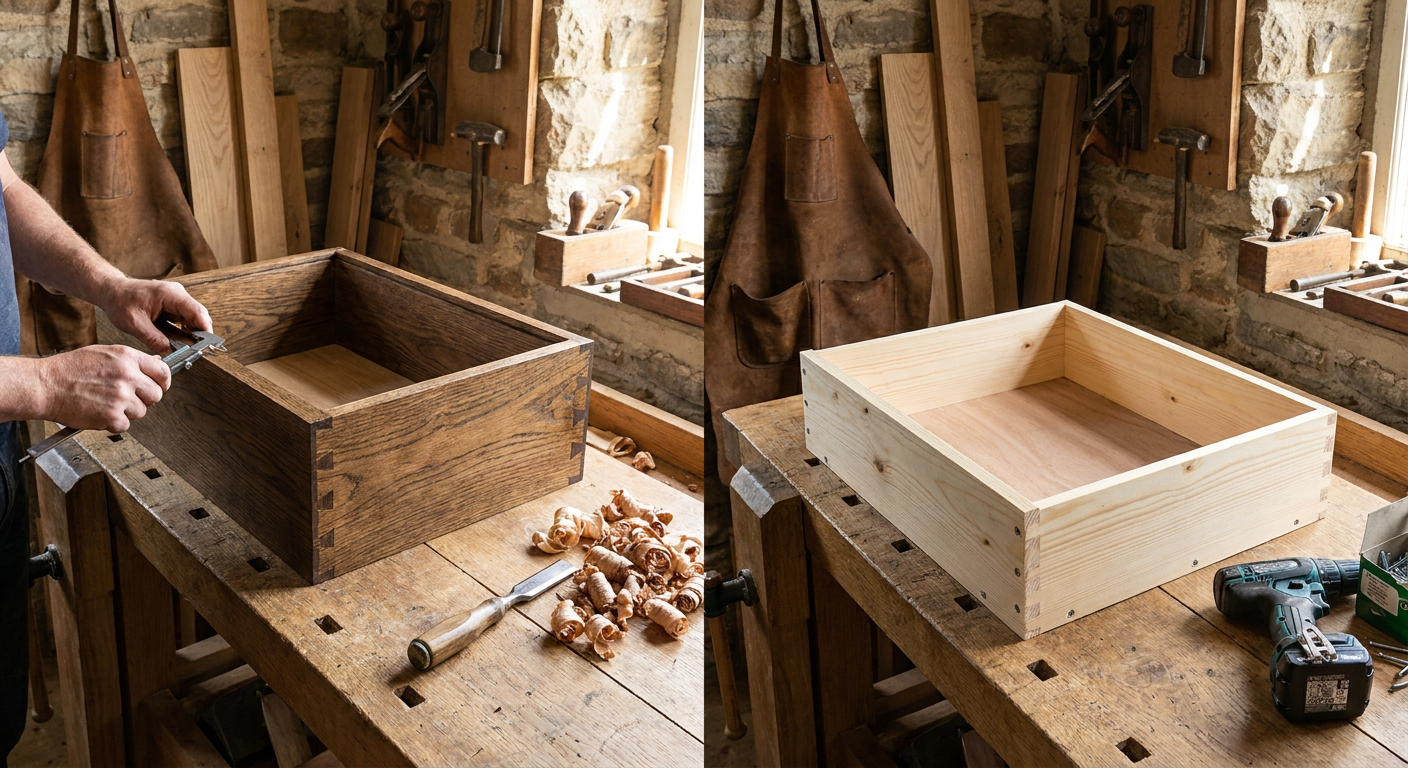
The main disadvantages of dovetail drawers are higher cost, longer build times, and the need for a skilled maker to cut them properly. Each tail and pin is sawn by hand or routed with care, which adds labour hours you do not get with a stapled or dowelled box. Repair is also harder: a damaged dovetail cannot be patched with filler, it must be re-cut and re-glued by someone who knows the joint. In our Yorkshire workshop we have re-housed drawer fronts on 1990s cabinets where the original dovetails were still sound after three decades of kitchen use, proof that the joint rarely fails even when the face panel does.
Why are dovetail drawers better?
Dovetail drawers are better because the interlocking wedges lock mechanically, so the joint grows tighter under load rather than loosening. There are no staples or nails to work free, no glue line to creep, and the drawer can be cycled thousands of times without racking. The joint also lets us use thinner, lighter stock without sacrificing strength, which maximises the internal storage volume of each drawer. For a busy family kitchen that means deeper usable space inside the same cabinet footprint, and it tilts the dovetail drawers vs standard decision firmly in favour of dovetail for daily-use rooms.
Is dovetail the highest quality?
Yes, a hand-cut dovetail is widely regarded as the highest-quality drawer joint available, though “highest quality” depends on who is cutting it. Through dovetails expose the craftsmanship and are the traditional hallmark of fine furniture; half-blind dovetails hide the joint for a cleaner face; English dovetails add extra mechanical grip at the front; French dovetails suit curved fronts on specialist pieces. A machine-cut dovetail from a good jig still outperforms any stapled standard drawer, but it lacks the tight fit and pride of a joint sawn by eye.
The decision rule we use at Oak & Pine by Design
Before we specify a drawer joint, we ask three things: how heavy is the load, how visible is the drawer, and how long should the piece last. Kitchens, wardrobes, and bedroom storage get through or half-blind dovetails in oak, maple, or beech, including shaker styles where a flush front is part of the brief. Light-duty drawer boxes inside painted carcasses can use a clean dowel or rebate joint if the budget demands it, but we always flag the trade-off to the client so the choice is theirs. As a Guild of Master Craftsmen-accredited workshop, we keep one workshop handling all ranges so every box, from painted shaker to traditional in-frame, is held to the same standard. If you are comparing quotes, ask every workshop the same question: what joint sits inside the drawer box, and who cuts it.
Dovetail Drawers FAQ and Your Next Step With Oak & Pine by Design
Are dovetail drawers worth it? Yes, when the drawer needs to carry weight, open thousands of times, and last decades. The joint locks mechanically, so it does not depend on glue or staples staying sound. For a kitchen, bedroom dresser, or under-stair pull-out, that strength matters every single day, and it is the clearest answer in the dovetail drawers vs standard question for busy rooms.
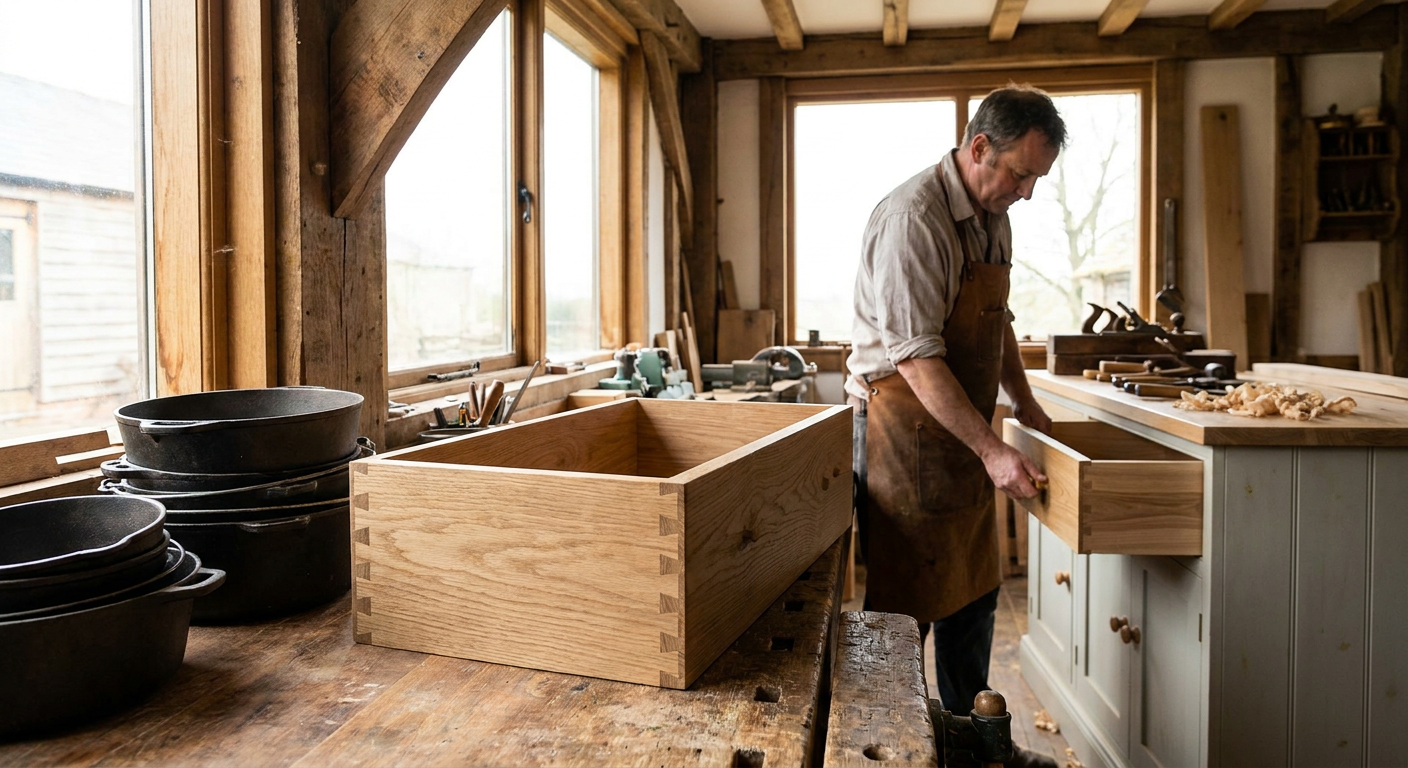
Are dovetail drawers more expensive? Usually, because each tail and pin is cut by hand or with a jig, then fitted, glued, and cleaned up one drawer at a time. A standard drawer box can be assembled in minutes on a production line. Expect roughly 1.5× to 3× the cost per drawer, depending on timber, size, and joint style.
Why are dovetail drawers better? They resist the two forces that ruin ordinary drawers: the sideways pull of opening and the downward sag of stored weight. Because the wedges interlock, a dovetailed side cannot slide off the front even if every pin is loose. Standard butt or stapled joints rely on fasteners that slowly work free with humidity changes.
Is dovetail the highest quality? In joinery terms, yes, though "highest quality" is not one thing. A through dovetail is the strongest and most traditional; a half-blind dovetail gives a clean front face; English dovetail packs more gluing surface into the same space. Each is the right choice for a different brief, and none beats the others in every situation.
What are the disadvantages of dovetail drawers? Cost and lead time are the honest ones. Hand-cut dovetails add days to a build, and a skilled maker's hourly rate is real money. Maple and oak, the timbers we most often use for dovetailed boxes, are heavier than MDF or plywood, so carcasses weigh more. Repairs are also harder: if a side is damaged, the joint usually has to be cut apart rather than unscrewed.
How to choose the right drawer for your project
Use this rule of thumb from our workshop:
- Daily-use kitchen and bedroom drawers: full dovetail, 12mm to 18mm hardwood sides, soft-close runners.
- Dresser internals and side tables: half-blind dovetail, keeping the face clean.
- Light-duty office or display drawers: standard rabbet or dowel construction is acceptable and saves budget for better timber on the carcase.
If you are weighing dovetail drawers vs standard options for a kitchen, wardrobe, or freestanding piece, bring your measurements and a short list of what each drawer will hold. We will quote both routes honestly, including where a standard drawer genuinely does the job and where a dovetailed box will pay you back over twenty years of service.

Sources
- Dovetail Drawers vs Standard: What’s the Difference?
- What Are Dovetail Drawers? | Eagle Woodworking
- Dovetail Drawers: What They Are and Why You Want Them
- Dovetail Drawers: What, How, and Why? - Fast Cabinet Doors
- What Are Dovetail Drawer Boxes? Why They Matter in Cabinet Quality - ProCraft Cabinetry DC
- Dovetail Drawers: Strength, Beauty and Benefits - Cabinfield Blog
- What Is a Dovetail Drawer Box?
- When buying custom kitchen cabinets, how important are dovetail ...