
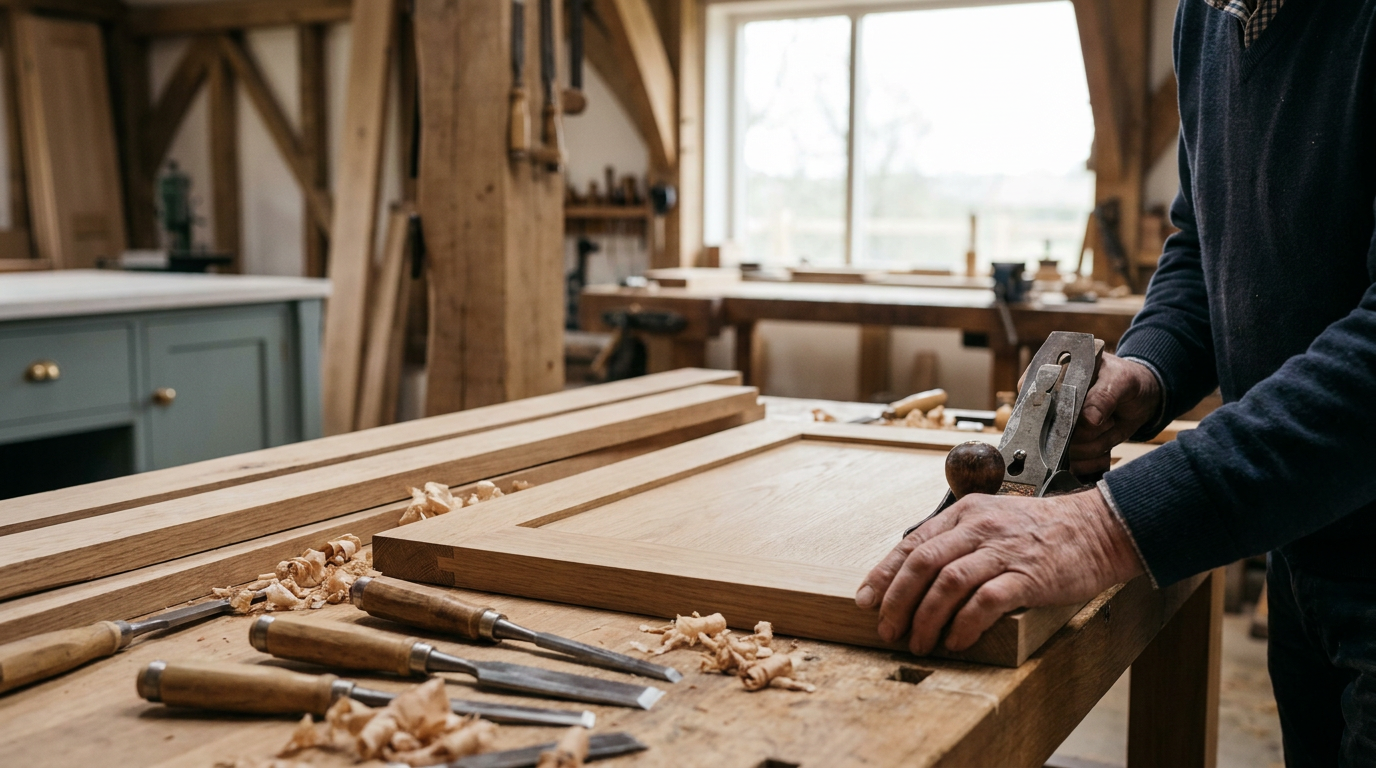
Quick answer: how to tell if a kitchen is bespoke
Knowing how to tell if a kitchen is bespoke comes down to four checks: original drawings, millimetre-precise sizing, freedom over timber and hardware, and one maker overseeing the project from survey to installation.
If a supplier works from set sizes, charges extra for deviations, or limits you to a fixed range, the kitchen is made-to-measure at best.
The word bespoke comes from the old verb "bespeak" — to speak for something before it is made. In kitchens, that means cabinetry, worktops, and fittings are produced solely for your project. Nothing leaves the workshop until the joiner has measured your room, understood how you cook, and designed around your walls, ceiling height, and awkward corners.
Use this checklist when visiting a showroom or speaking with a maker:
- Origin of the design: Is it drawn from scratch, or adapted from an existing range?
- Dimensions: Are cabinets built to your exact sizes, including filler panels for uneven walls?
- Materials: Can you specify the timber species, finish, and hardware, or are you limited to set options?
- Storage: Will interiors be configured for your pans, larder goods, and appliances — or do you pick from standard inserts?
- Process: Does one maker oversee the project from first sketch to final install?
- Provenance: Can the workshop name be verified, and can you visit it?
Trade-offs to weigh: a bespoke kitchen takes longer — often 8 to 14 weeks once designs are signed off — and costs more than a modular equivalent. It fits unusual spaces, lasts decades, and adds measurable value to period properties across the UK. If speed and a tight budget matter more than a perfect fit, a quality made-to-measure kitchen may serve you better. If long-term quality and a room-specific design matter most, bespoke earns its premium.
What a genuinely bespoke kitchen actually involves
What makes a kitchen bespoke
A bespoke kitchen is built from scratch around your room, your habits, and your measurements, rather than assembled from a supplier's standard sizes or adjusted templates. The answer to how to tell if a kitchen is bespoke starts with the design process itself: every cabinet, panel, and drawer should be a one-off, planned for that space.
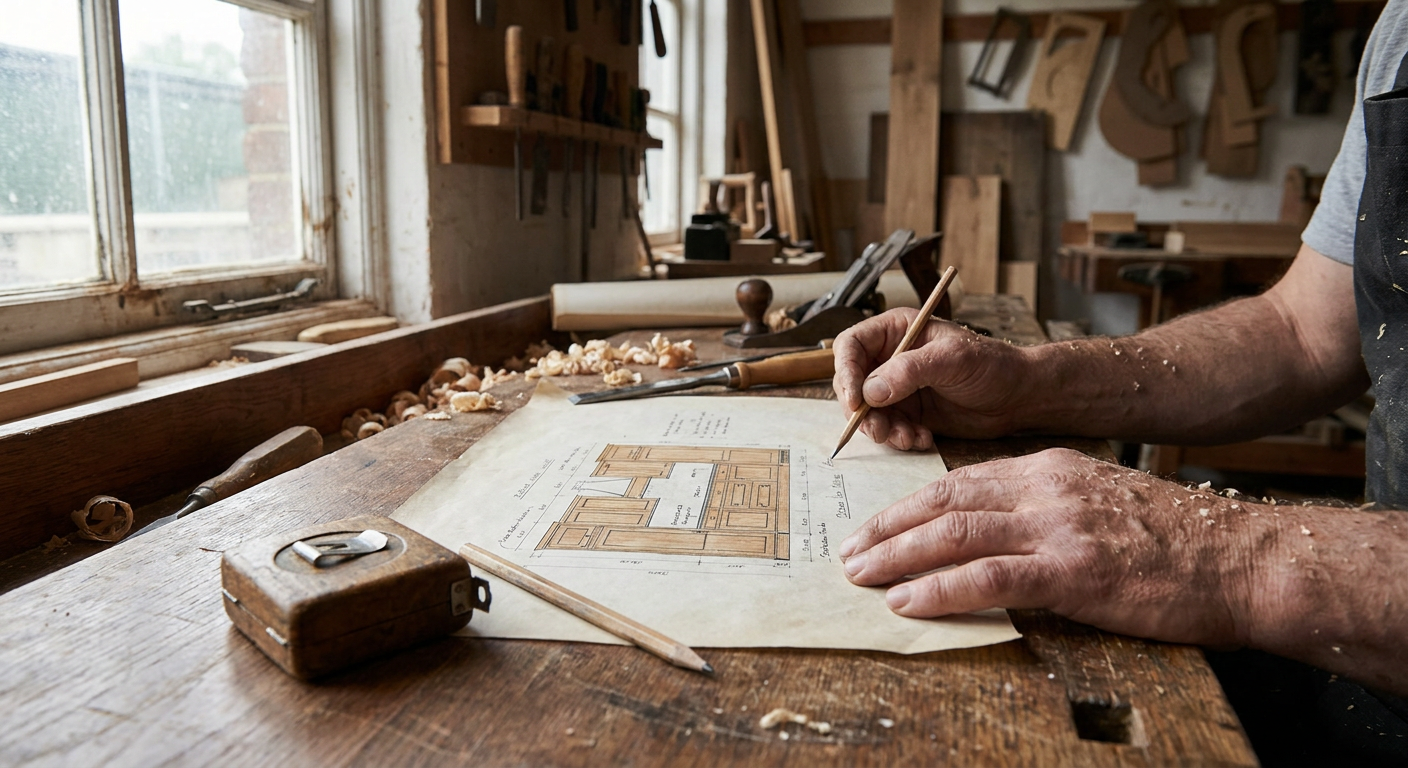
The first things to look at
- Sizing: units measured to the millimetre, not slotted into set widths.
- Drawings: original sketches or CAD work produced only after a site survey.
- Materials: timbers, paints, and finishes chosen with you, not selected from a fixed price list.
- Joinery: dovetailed drawers, in-frame carcasses, and hand-finished surfaces rather than flat-pack fixings.
- Hardware: hinges and handles specified to suit the door weight, not generic stock items.
Custom sizing, joinery and materials chosen for the room, not a catalogue
At Oak & Pine by Design, every project begins with a measure-up at your home, followed by scaled drawings that resolve awkward corners, sloping ceilings, and uneven reveals. Founder Daniel Fitzpatrick then specifies timbers air-dried in the workshop — oak, beech, painted tulipwood, reclaimed pine — and pairs them with traditional joinery such as mortise-and-tenon frames and hand-cut dovetails. Filler panels are unnecessary here; every run is built to length, so the cabinetry reads as continuous furniture rather than a kit of parts. The result is a room that feels integrated, not just fitted.
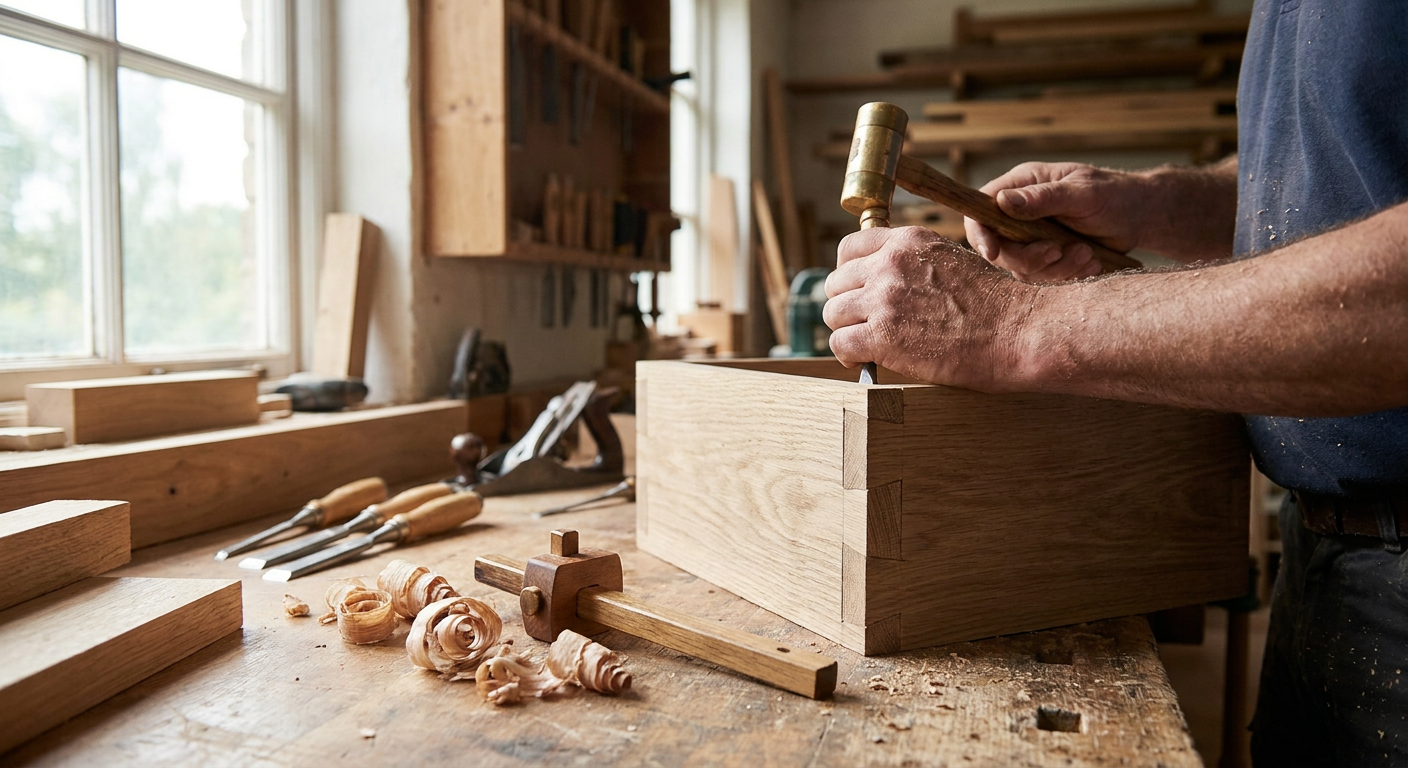
How to spot the difference between bespoke, made-to-measure and handmade
The three terms blur on showroom floors. A handmade kitchen draws on skilled craftsmanship but still comes from a curated range, with set door styles and limited size options. A made-to-measure kitchen starts as an off-the-shelf modular system, then trims or extends units to fit your room — clever, but constrained. A truly bespoke kitchen discards the range altogether: you choose the proportions, the internals, the timber, and the finish. Quick test questions: can the maker change the depth of a cabinet by 20mm with no surcharge? Will they build around a chimney breast rather than hide it? If the answer is yes, you are looking at bespoke. For a practical next step, speak to the workshop with your room dimensions and a shortlist of must-have storage.
How to find out who made your kitchen
Practical ways to trace a kitchen's maker, from drawer checks to paperwork
Start inside the drawers and cabinet doors. Most quality makers stamp or label the back of drawers, the underside of shelves, or behind the hinge plates. Use a torch and a phone camera in the tight spots.
- Check drawer runners and hinges: Blum, Hettich, and Grass leave distinctive marks and sometimes serial numbers. Note the brand, then search the maker's directory.
- Look inside end panels: bespoke joiners often pencil a job number, date, or initials on the back of a filler panel. It is a quiet signature left by the maker.
- Review original paperwork: the surveyor's drawing set, the quote, and the invoice should name the workshop. Estate agents often keep copies from the original sale.
- Inspect worktops and splashbacks: stone fabricators template their work, so a discreet label is often fixed under the hob cut-out or beneath a sink panel.
Ask the previous owner or the kitchen fitter who installed it. Fitters keep records of every job and will remember a Yorkshire workshop within minutes.
Visiting a workshop or showroom to verify a maker's claims
A maker with nothing to hide invites you in. Visit while a job is on the bench so you can see carcasses being glued, dovetailed, and hand-finished. Look for in-frame construction, solid timber edging, and drawers assembled with hand-cut joints rather than stapled packets.
At Oak & Pine by Design, every project passes through one workshop in Yorkshire under Daniel Fitzpatrick's direct eye, from initial survey through to hand-finishing. Ask to see a current job, sample drawer boxes, and a doors-off sample of a carcase. Guild of Master Craftsmen accreditation is worth confirming, because the guild issues certificates with serial numbers that tie back to the registrant.
Take a photograph of any unusual joint and the timber species used on drawer bases and backs. Genuine bespoke work uses solid oak, beech, or mahogany throughout; MDF or chipboard backs are a giveaway of a modular origin.
A trustworthy maker will name their timber merchant on request. Sourcing from certified suppliers is a quick credibility check you can repeat with any shortlist.
Are Wren kitchens bespoke, and what about other big names?
Where Wren sits on the bespoke scale and what that means for buyers
Wren Kitchens is not a bespoke maker in the strict sense; it is a high-volume retailer selling made-to-measure ranges adapted from fixed collections. Cabinets come in set sizes, standard colours, and a curated finish library. Wren excels at showroom presentation, fitted design appointments, and fast installation across the UK, but the product itself is built on modular templates.
For most homeowners that trade-off is acceptable. You get a tidy, well-engineered kitchen in roughly four to six weeks, with predictable pricing and a strong warranty network. You do not get a cabinet built to a 17th-century Yorkshire stone cottage with uneven walls, or a larder sized around an original chimney breast.
Other names worth comparing sit further along the spectrum:
- Howdens: trade-only modular units, strong on price, limited on true customisation.
- Magnet and Wickes: similar mid-market made-to-measure models.
- Smallbone and deVOL: handmade ranges with curated collections, not from-scratch joinery.
- Independent workshops such as Oak & Pine by Design build every cabinet to the millimetre in a single Yorkshire workshop, using sustainably sourced timber and traditional joinery.
Questions to ask any kitchen company before you trust the word bespoke
Ask whether the carcass is built from scratch or assembled from a range. Ask who cuts the joints, hand-finishes the timber, and signs off the final fit. Ask to visit the workshop, not just the showroom, and to see a job in progress.
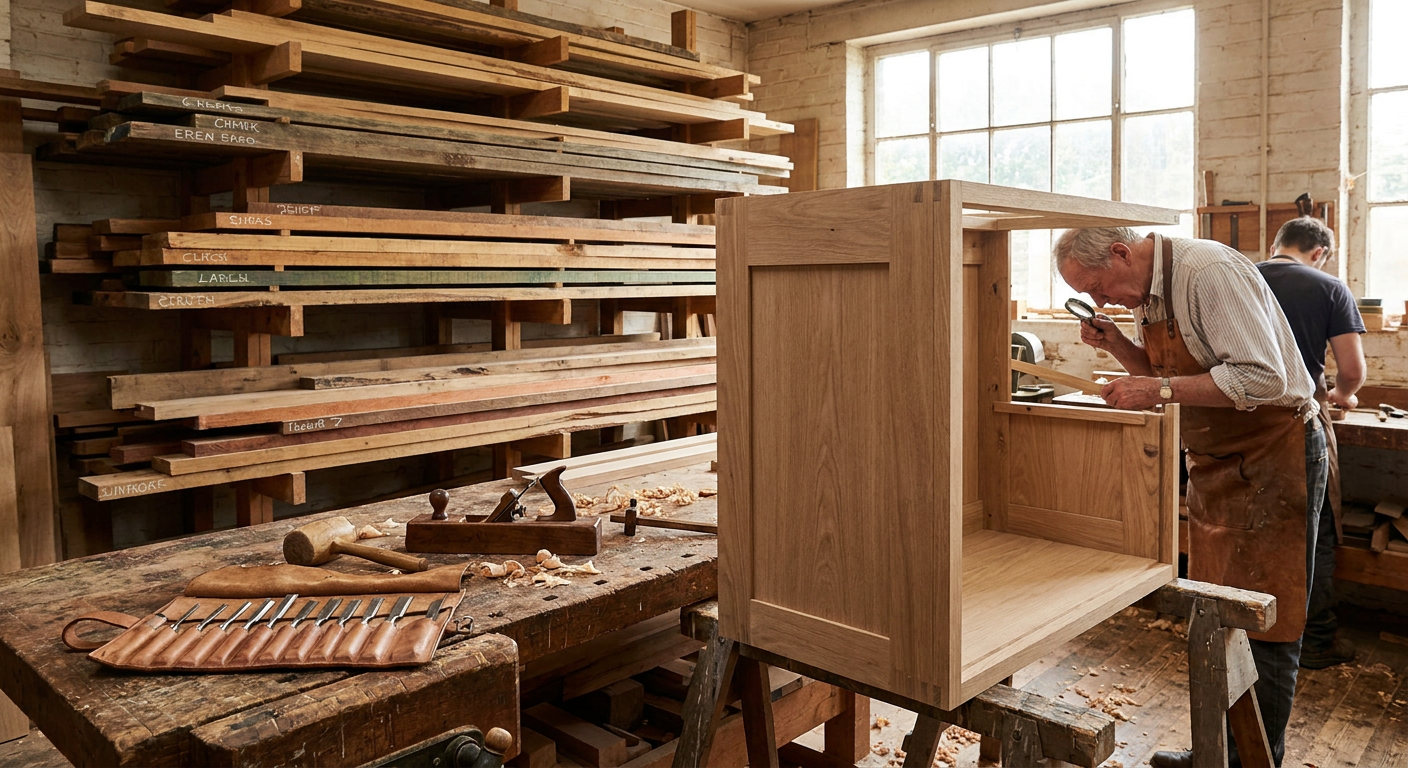
Three questions separate marketing from craft:
- Are all dimensions made to measure, including filler panels and end panels?
- Can you choose any timber species, paint finish, or hardware without a premium surcharge?
- Does one maker oversee design, build, and installation, or are these handed between departments?
If the answer to the first question is no, you are buying a customised standard kitchen, not a bespoke one. Price tags of £40,000 to £80,000 are common for true bespoke work; anything markedly below should prompt closer inspection of what is actually being built.
For homeowners weighing whether a workshop build is worth the investment over a Wren or Howdens order, our bespoke kitchen service page walks through the process, timelines, and material choices in detail.
Common questions about how to tell if a kitchen is bespoke
What makes a kitchen bespoke?
A bespoke kitchen is built from scratch around your space, brief, and habits, with every cabinet, drawer, and fitting made to exact measurements. Nothing is pulled from a standard range or stretched to fit a template. The result is a room designed for the way you cook, store, and live, rather than for a catalogue.
How do I tell who made my kitchen?
Look inside cabinets and drawers for a maker's stamp, label, or engraved logo on hinges, drawer runners, or the back of doors. If nothing is visible, check the original paperwork, ask the previous owner, or lift a kickboard or filler panel to look for workshop marks or batch numbers. A craftsman proud of the work usually leaves a trail.
Are Wren kitchens bespoke?
Wren Kitchens sells made-to-measure and rigid modular kitchens based on its own ranges, not true bespoke work. You can choose finishes, colours, and handles, but the carcasses, sizes, and layouts follow Wren's own systems. For a fully custom build, you would need a workshop that designs and constructs every element from the ground up.
Is a bespoke kitchen more expensive?
Yes, a bespoke kitchen costs more than flat-pack or modular options because every part is custom-made by hand. You are paying for materials, joinery time, and one-to-one design input rather than mass production. The trade-off is longevity, a better fit for awkward spaces, and a room that no one else owns.
If you are weighing options, visit the workshop before you commit. Seeing carcasses being assembled, handles fitted, and finishes applied tells you more than any brochure. Explore our bespoke kitchen service to see how each project moves from first sketch to final installation.
Next steps: how to move from reading to a finished kitchen
Deciding on a new kitchen is rarely about finding a price; it is about trusting the people who will build and install it. The clearest path forward is a short, practical conversation with a workshop that handles every stage in-house, from the first sketch to the final hand-finish.
A short checklist for choosing a maker
- Ask who builds it. Request the name of the craftsman, the workshop location, and proof of accreditation such as Guild of Master Craftsmen membership.
- Visit the workshop in person. Seeing machines, timber stores, and finished pieces tells you more than any brochure.
- Inspect a carcass before you commit. Look for in-frame construction, dovetailed drawers, and solid timber rather than wrapped MDF.
- Test the hardware. Open every drawer and door. Soft-close hinges and properly aligned runners are a quiet sign of care.
- Check customisation depth. Can the maker change the depth of a larder, the height of a bank, or the curve of a filler panel around a chimney breast?
- Confirm the process. Expect a measured survey, drawn design, sample finishes, and a single point of contact from start to fitting.
When to bring in a workshop like Oak & Pine by Design
Bring in a master craftsman workshop when the kitchen must fit an unusual room, when you want timber chosen and seasoned by hand, or when you expect the same person to design, build, and oversee the installation. Founder Daniel Fitzpatrick has spent more than 25 years in his Yorkshire workshop, working in oak, pine, beech, mahogany, maple, painted finishes, reclaimed pine, and shaker styles. Every project passes through one workshop, with personal oversight from the first line on paper to the last brush of wax.
The trade-off is lead time. A genuinely hand-built kitchen takes longer than a flat-pack or modular order, and a waiting list of several months is common. In return, you gain a kitchen fitted to the millimetre, built to outlive the next renovation, and finished by a single accountable maker.
Next step: book a workshop visit or send your room dimensions to Oak & Pine by Design for an initial conversation about your space, your timber preferences, and a realistic timeline.
Sources
- Naked Kitchens - Bespoke Kitchens, Built For Life
- What is a Bespoke Kitchen? - Hunt Bespoke Kitchens & Interiors
- Bespoke vs Handmade Kitchens | What's The Difference?
- What is Bespoke Kitchen Design? | Modiani Kitchens
- 103 kitchen ideas to help you cook up the ideal design | House & Garden
- 10 Outdated Kitchen Design Features to Address When Remodeling — DESIGNED
- 10 KITCHEN DESIGN ELEMENTS TO INCLUDE IN YOUR KITCHEN RENOVATION
- 11 Must-Have Kitchen Features That Changed Everything