
What is a shaker kitchen: definition, history and how to build one properly
Quick answer: what is a shaker kitchen
The short definition
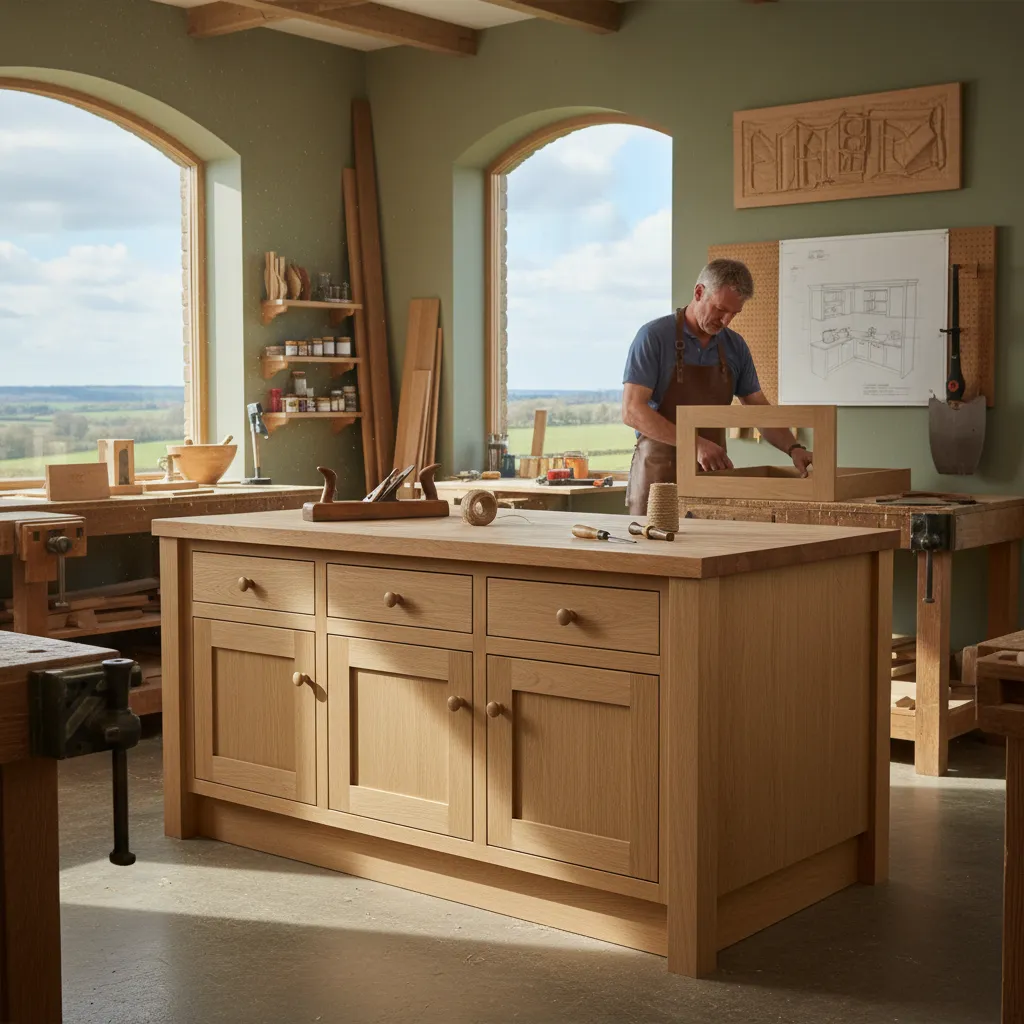
A shaker kitchen is a fitted kitchen built around simple five-piece shaker doors with a flat recessed centre panel, square edges and honest materials, designed for function over decoration.
The look takes its name from the Shakers, an 18th-century religious community in America whose craft principles still shape how these kitchens are built today.
What the style actually looks like
The cabinet door is the giveaway. Two vertical stiles and two horizontal rails frame a flat panel that sits set back, almost flush, inside the opening. There is no moulding, no carved detail and no bevel. Drawer fronts follow the same construction. Hardware is small and plain: a round knob, a slim cup pull, or a simple bar handle in brushed brass, aged bronze or chrome.
How a workshop reads it differently from a retailer
A genuine shaker kitchen door, made the way we make them in our West Yorkshire workshop, has solid timber stiles and rails with a real tongue-and-groove floating panel set in a groove, glued only on the top of the panel so it can move with the seasons. A machine-cut MDF imitation uses a routed single board with a printed profile. Look at the panel edge: you should see end grain on the rails and stiles where they meet, not a continuous printed grain running across the joint.
Why homeowners still choose it
The style suits a Yorkshire stone cottage, a Georgian terrace in Harrogate and a new-build in Leeds equally well. It takes paint cleanly, accepts any worktop from oak to marble, and ages rather than dates. That is why three decades of clients have asked for it.
To see how a hand-built shaker kitchen would look in your home, call 01484 666 333 or visit our handmade kitchens Yorkshire workshop page.
Why is it called a shaker kitchen
The Shakers: from Manchester to America
A shaker kitchen takes its name from the Shakers, a small Christian community that began in 18th-century Manchester as a breakaway from the Quakers. Neighbours called them "Shaking Quakers" for the trembling and dancing that marked their worship, and the label stuck even after they renamed themselves the United Society of Believers in Christ's Second Appearing. Around 1774, small groups sailed to America and built self-contained villages across New York and New England, where they lived, farmed and worked wood.
How a religious principle became a design language
The Shakers held that anything false, including unnecessary decoration, was a form of dishonesty. Their craftsmen translated that belief into furniture built from solid timber, joined with dovetails and mortise-and-tenon joints, and finished without veneer or stain. Drawer fronts, peg rails and chair posts stayed plain; a single round wooden knob was enough for a hand to find. Those rules produced a cabinet door made of five flat pieces, a recessed centre panel set into four square rails, that reads honestly from across a room. When American makers sold similar cabinetry from the 1960s onwards, the style arrived back in England already known as a shaker kitchen, carrying two centuries of workshop principle in its frame.
What defines a shaker style kitchen
The five-piece door, broken down
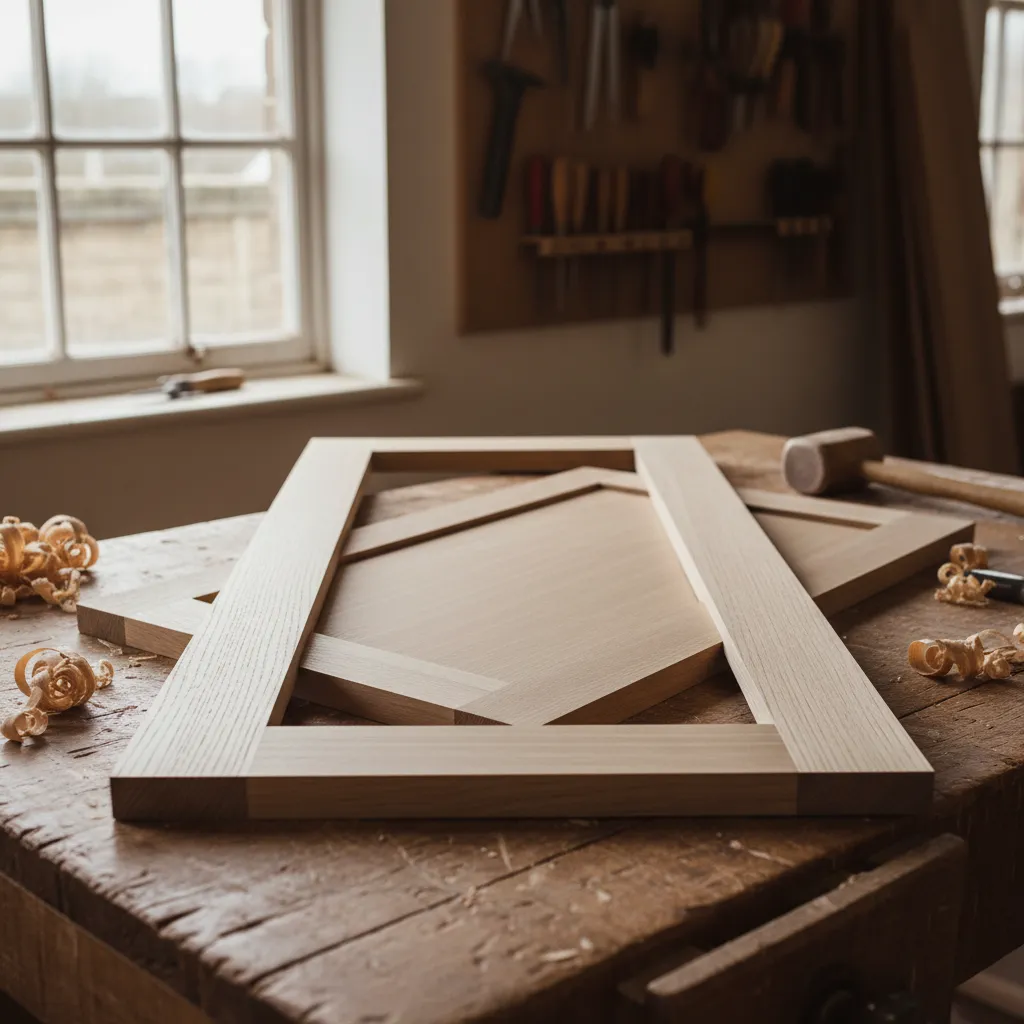
A shaker style kitchen is defined by its five-piece door: two vertical stiles, two horizontal rails and a flat recessed centre panel, all with square edges and no moulding. The stiles and rails frame the panel like a picture, and each joint is typically a mortise and tenon, glued and sometimes pinned, rather than a routed groove holding an MDF insert. That is where most retailers cut corners, and where the eye can tell the difference after a few years of use.
Shaker doors, cabinetry and hardware cues
The shaker doors on the cabinets are usually in-frame, meaning the doors and drawer fronts sit within a face frame and shut against it with a small, even gap. Drawers are dovetailed, not stapled. Hardware stays simple: round wooden knobs, slim cup handles or plain bar pulls, never ornate. The layout favours symmetry, aligned runs and a place for everything, which is why the style suits both a Yorkshire stone cottage and a new-build.
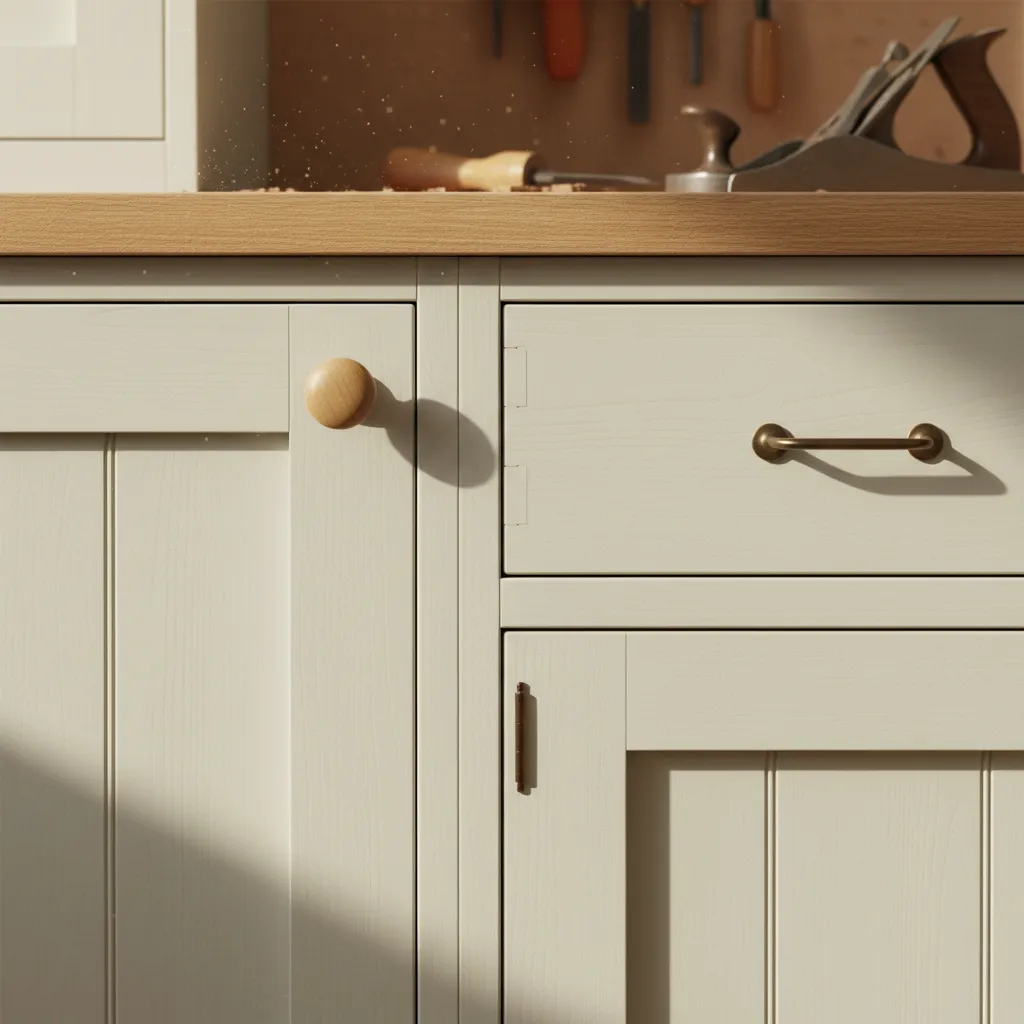
For shaker kitchen ideas drawn from our own commissions, browse the workshop's shaker range to see how the five-piece door is built by hand, then call 01484 666 333 to discuss your own layout.
What is the difference between a shaker kitchen and a traditional kitchen
Plain Shaker versus ornate traditional
A Shaker kitchen is built around clean, flat panels and square edges, while a traditional kitchen tends to carry moulded cornices, glazing bars and decorative corbels. The distinction comes down to what each style treats as decoration: Shaker work removes it, traditional work adds it.
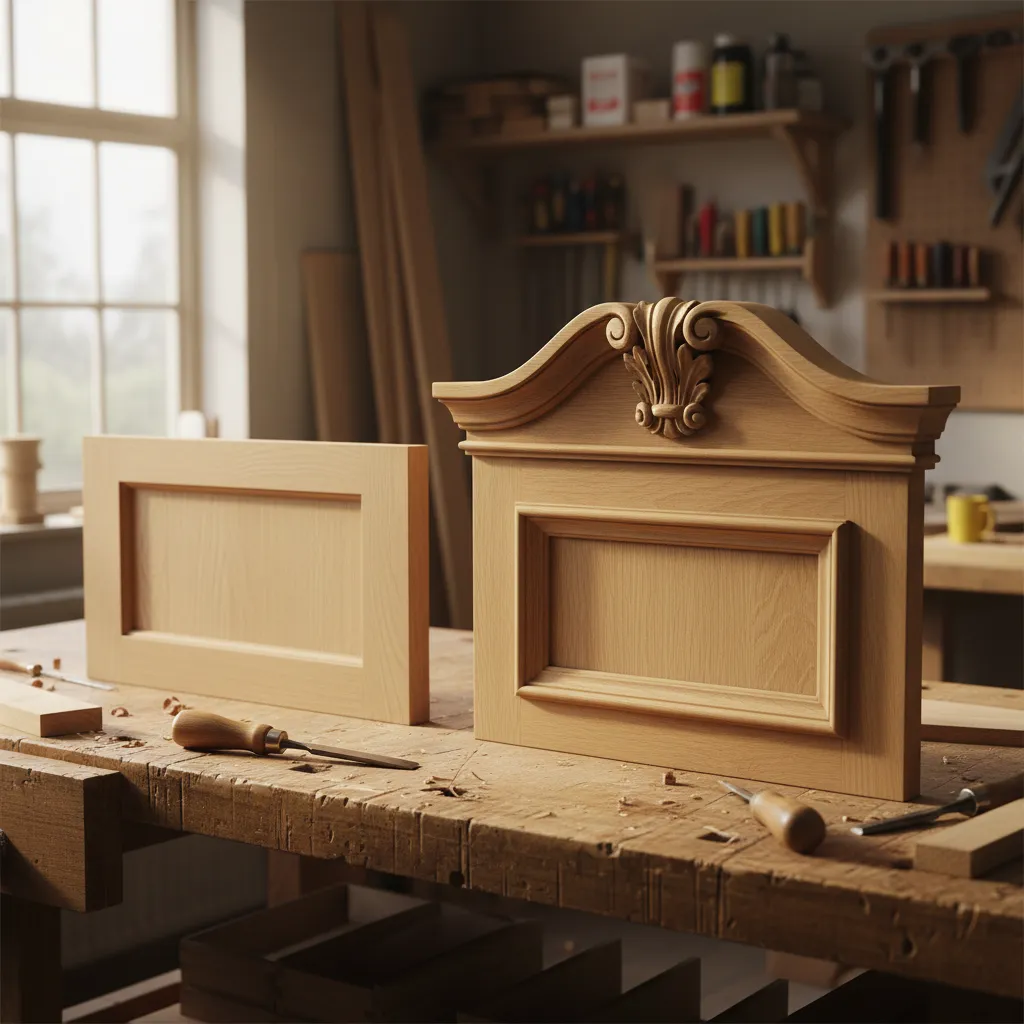
You can see it on a single drawer front. A Shaker door shows two vertical stiles, two horizontal rails and a recessed centre panel, all meeting at right angles with no profiling. A traditional door often adds a chamfer, a bolection mould or a bead running along the inside of the frame.
The same principle carries through to the cabinetry. Shaker cabinets sit flush with simple gaps between doors and rely on a single round knob or slim cup pull. Traditional units use paired handles, pilasters, cornice lighting pelmets and sometimes glass-fronted dressers.
Both styles use solid timber, painted finishes and timber worktops, so the difference is in the joinery choices a maker commits to, not the materials on the bench.
Why both styles belong in period homes in England
Stone mullions, flagstone floors and low ceilings in a Yorkshire cottage or Georgian townhouse look correct beside either style once the proportions are right. A Shaker kitchen reads as a quiet, modern intervention; an ornate traditional reads as a continuation of the room's period joinery.
Choose Shaker when the original room already carries plenty of detail, such as exposed beams, an Aga or a stone fireplace, and you want the cabinetry to step back. Choose ornate traditional when the kitchen sits inside a formal dining room, a panelled snug or a listed interior where moulded details echo skirtings and architraves.
Both work in England because both are built on solid timber frames, dovetailed drawers and hand-finished paint, which is what period homes actually need.
How a real shaker door is built in solid timber
Mortise and tenon joinery in the workshop
Every door we make starts with a square-edged stile and rail, cut from a single board of oak, maple or birch. The joint where they meet is a mortise and tenon: a rectangular slot is chopped into one rail, a matching tongue is cut on the end of the other, and the two are driven together with a hide-glue face. The shoulder shows a clean line across the rail, and the joint can be sanded flush without losing strength.
Solid wood versus routed MDF, and what you actually receive
A solid-timber door is five loose pieces of wood, glued and pegged, that move with the seasons. A routed MDF door is a single sheet milled into a one-piece frame-and-panel shape, then sealed with foils or paint. The MDF copy is lighter; it cannot be repaired when the coating lifts, and any swelling at the edge shows as a fuzzy line around the stile. A genuinely made solid wood kitchen units can be re-glued, re-polished or repainted twenty years on. We have clients who sent doors back to the workshop after fifteen years for a repaint and new hinges, rather than a replacement kitchen.
Choosing materials, finishes and worktops for shaker cabinets
Oak, pine, beech, painted and reclaimed timber options
Oak is the traditional choice for a shaker kitchen because its tight, straight grain takes a crisp square edge and holds a recessed centre panel without movement. Most clients choose European oak for visible units and American white oak for statement islands. Beech is a close cousin in shaker styles because its pale, even grain and tight pores take paint cleanly, making it a favourite for painted kitchen units where the door needs to read flat rather than busy. Pine is softer, marks more easily and suits a country setting where a little patina is welcome. Reclaimed pine brings saw marks, old nail holes and a grey weathered tone you cannot buy new. Painted finishes use a primed MDF or tulipwood centre panel under a hand-painted topcoat, because solid timber panels move seasonally and telegraph through paint within a year.
Hardware and worktop pairings that respect the style
Hardware should match the cabinet's honesty: simple turned oak knobs, beeswaxed cup handles or a slim satin brass D-pull. Anything chrome-glossy or ornate will fight the five-piece door. For worktops, a 30mm oak or maple top continues the timber language, while honed marble, black granite or limestone reads as the modern wooden kitchen interpretation. Keep the edge profile square, not bullnosed, to stay true to the original Shakers' belief that every line should earn its place.
Request a sample pack of door, paint chip and worktop offcuts through our contact page before you commit.
Shaker kitchen questions, answered
Are shaker kitchens expensive?
Yes, a handmade shaker kitchen sits at the upper end of the market, though the price depends almost entirely on how it is made, not on the style itself. A flat-pack MDF unit with a routered faux-frame door sits at one end of the scale. A handmade, solid-timber shaker kitchen with dovetailed drawers, in-frame construction and hand-painted cabinet doors sits at the other. The trade-off is durability: a properly jointed solid wood kitchen from a Yorkshire workshop can be repaired and repainted for decades, while a thin MDF version will swell if a seal fails. Bespoke kitchens in oak from a small workshop typically cost more than a high-street fit-out, but they outlast two or three cheaper replacements.
Shaker versus modern kitchens, which suits you?
Modern handleless kitchens rely on clean slab doors and push-to-open mechanisms. Shaker kitchens rely on a visible five-piece door, a flat centre panel and simple hardware such as a knob or cup pull. Choose shaker if you want a room that ages gracefully and can take a repaint in ten years. Choose modern if you want the absolute minimum of visible lines. Both work in a new-build; shaker often wins in a stone cottage or Georgian townhouse.
Where shaker style meets IKEA, B&Q and Wren
High-street ranges from IKEA, B&Q and Wren sell shaker-look doors made by routing grooves into MDF or foil-wrapped particleboard. They look acceptable on day one. Open a door after two winters in a Yorkshire kitchen and check the corners: you will see the difference between a routered groove and a real joint. A workshop-built door has separate stiles, rails and a floating panel, glued and pinned, not milled in one piece.
How do shaker colours change the feel of the room?
Shaker kitchen colours set the whole mood of the room because the flat panel and square edge catch light evenly across the face of the door. Soft putty greys, stone whites and inky navy are the most requested in our workshop; they sit quietly against timber worktops and stone floors. Bolder greens and warm charcoals work in larger rooms with plenty of daylight, while chalky off-whites brighten north-facing galley kitchens. Because the door is plain, the colour does the talking, which is why painted kitchen units are the most common finish we are asked to repaint ten years after install.
See how a genuine shaker door is made, or request a sample, by calling 01484 666 333 or emailing info@handmadekitchensyorkshire.co.uk.
Talk to a Yorkshire workshop about your shaker project
How we work, from sketch to install
A project starts with a conversation in our West Yorkshire workshop, often with a rough sketch on the bench and a handful of timber samples. From there, founder Daniel Fitzpatrick draws every elevation by hand, working out panel sizes, rail widths and storage requirements against your room.
Once a design is signed off, we cut timber from sustainably sourced stock and cut every joint in-house: mortise and tenon for the frames, dovetails for the drawers. Nothing leaves the bench until doors hang square and drawers run true. Installation is handled by the same hands that built the cabinets, so what was drawn in the workshop is what arrives in your home. For clients weighing bespoke kitchens and furniture against a high-street fit-out, this in-house route is what makes the difference on site.
Your next step with Oak & Pine by Design
If a handmade shaker kitchen is on your horizon, the simplest move is a short phone call to the workshop on 01484 666 333 or an email to info@handmadekitchensyorkshire.co.uk. Tell us your room size, your preferred timber and any sketches you already have, and we will book a face-to-face consultation at our West Yorkshire workshop within the week.